
Language on Autopilot or Language with Intention?
I was standing in a shop recently when I overheard a conversation between a shop assistant and a customer.
"Hi, how are you?" she asked.
"Good thanks, how are you?" he replied.
"Good thanks, how are you?" she responded.
I had to smile. She hadn't even noticed that she'd already asked him how he was!
It got me pondering about how often we use words and phrases without really thinking about what we're saying. "Hi, how are you?" must be one of the most common greetings we use here in Aotearoa New Zealand. We say it to friends, colleagues, strangers and people serving us in shops.
But are we really asking how someone is?
And perhaps more importantly, are we actually interested in the answer?
Most of us know the expected response. "Good thanks, and you?" And on we go. It's almost a rehearsed exchange, a social ritual that requires very little thought from either person.
But what if someone actually told us how they were?
"Well, yesterday was pretty awful, but I'm feeling a lot better today, thanks for asking."
Would we stop and listen? Would we be surprised that someone had actually answered our question?
It made me wonder why we don't simply say hello. A warm greeting, a smile, a moment of eye contact. Surely that can be enough without asking a question we have little intention of exploring.
Interestingly, later that same day, I had a very different experience.
I was being served by a man whose accent caught my attention. Curious, I asked where he was from.
Cornwall, he told me.
That simple question led to a lovely conversation. He had been living in New Zealand for three years. He was facing the uncertainty of renewing his visa, looking for work in his trade, and considering whether he might need to move to Hamilton.
For a few moments, I had the privilege of hearing a little of his story.
There was nothing particularly extraordinary about our conversation. I didn't set out to have a meaningful interaction. I simply noticed something, became curious, asked a question and listened to his response.
The difference between these two conversations wasn't necessarily the questions themselves. It was the curiosity behind them.
And before I go any further, I need to acknowledge that I'm just as capable as anyone else of asking "How are you?" without really listening to the answer. This isn't about pointing fingers. It's about noticing our habits and wondering whether, with a little more intention, we might do things differently.

When language becomes a habit
Another experience last week added a different dimension to my pondering.
I was sitting with a kaiako who repeatedly called me "ma'am".
Now, I know my name is Lynn, and they knew my name too. But each time they called me ma'am, I found myself thinking, Who is ma’am? Everyone calls me Lynn.
I eventually asked them not to call me ma'am, explaining that I didn't really recognise myself in that word.
They explained that, for them, calling someone ma'am was a sign of respect. It was how they acknowledged someone they held in regard.
And suddenly we had something interesting to think about.
Their intention was respectful. My experience of the language was different. From my cultural perspective, being addressed by a generic title didn't help me feel particularly seen or recognised as an individual.
Neither of us was necessarily wrong.
We were simply bringing different cultural understandings to the same interaction.
It also had me pondering about mana and the ways our everyday interactions can acknowledge, affirm or unintentionally diminish another person's sense of identity.
Our interactions have the potential to uphold and enhance the mana of others.
And perhaps this is where genuine listening becomes so important. We need to be willing to understand how another person experiences our words, rather than assuming our intentions will always be understood.
The conversation left me thinking about the language we use every day. The expressions that roll off our tongues because they're familiar, comfortable and perhaps so deeply embedded that we hardly notice them.
How often do we consider not just what we intend our words to mean, but how those words might be experienced by someone else?
And perhaps just as importantly, how willing are we to listen when someone offers us a different perspective?

What does this mean for kaiako?
These everyday experiences have had me pondering about the language we use in early childhood settings.
We talk a great deal about the importance of relationships, communication and responsive interactions. We encourage kaiako to ask questions, engage in conversations and extend the thinking and learning of tamariki.
But I wonder whether, at times, we've become so focused on asking questions that we've forgotten to consider why we're asking them.
"What's that colour?"
"How many blocks have you got?"
"What are you making?"
“What are you doing?”
None of these questions is necessarily wrong. Context matters. But what is our intention?
Are we genuinely curious about what the tamaiti is thinking or experiencing? Or are we asking questions because that's what we've become accustomed to doing?
I remember reading an article or blog written by Alison Brierley from Educational Leadership Project that challenged questions such as What Colour Is Your Lunchbox? (sorry I cannot find the article, maybe this was a workshop)
Questions that may have little connection to their interests, thinking or intentions.
What purpose do they serve? Whose agenda are they meeting? And how do they uphold the mana of the tamaiti? And our own - at our age should we not know what colour that is?
Perhaps we need to ask ourselves whether every interaction needs a question at all.
Sometimes noticing what a tamaiti is doing, sharing their delight, or simply being alongside them may offer far more opportunity for connection than another question.
A pedagogy of listening
Te Whāriki invites us to consider listening as a fundamental part of our relational pedagogy, particularly in our work with infants and toddlers.
A pedagogy of listening goes far beyond hearing spoken words. When we consider listening through the lens of whakamana and whanaungatanga, our interactions become about much more than exchanging words. They become opportunities to recognise the mana, identity and perspectives of each tamaiti, and to strengthen the relationships through which learning and belonging grow. Listening with intention means recognising that tamariki have their own whakaaro, their own ways of communicating and their own understandings of the world.
And perhaps it also means being willing to allow their perspectives to influence our own thinking, rather than always expecting them to respond to ours. It asks us to notice verbal and non-verbal communication, to pay attention to gestures, expressions, movement, gaze and silence. It requires us to recognise that tamariki communicate in many different ways, and that their perspectives, intentions and working theories deserve to be taken seriously.
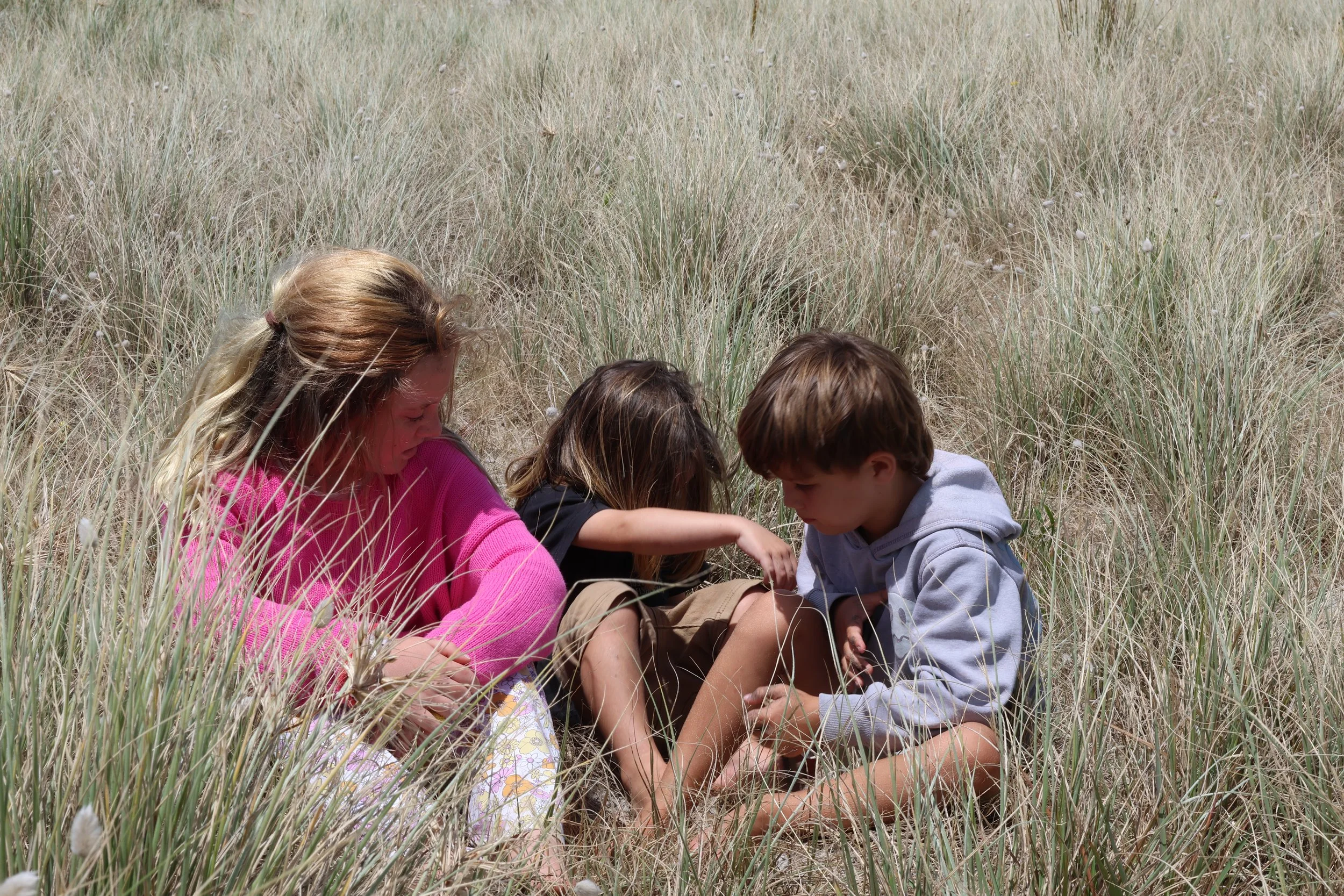
Listening involves giving tamariki time and space to communicate, rather than rushing to interpret, respond or direct.
I wonder whether this is where slowing down becomes so important.
Not necessarily slowing down the pace of everything we do, but slowing down our thinking and our responses.
Pausing long enough to notice.
Being comfortable with silence.
Resisting the urge to fill every moment with adult language.
Perhaps recognising that a tamaiti doesn't always need us to ask another question. Sometimes they need us to listen to what they are already telling us.
The language of everyday practice
I also wonder about some of the familiar expressions we use with tamariki.
"Good job!"
"Be careful!"
"You're okay."
"Use your words."
These phrases are often spoken with kindness and good intentions. But how often do we stop to consider what we're actually communicating?
When we say "You're okay" to a distressed tamaiti, are we acknowledging their experience or unintentionally dismissing it?
When we say "Good job", what are we recognising? Have we genuinely noticed something meaningful, or are we offering automatic praise?
And when we tell a tamaiti to "Use your words", are we recognising all the other ways they may already be communicating? Or maybe that they actually don’t have the words and that it is our role to support them with this.
Just as my experience of being called ma'am differed from the kaiako's intention, the way our language is experienced by tamariki may not always match what we intended.
This isn't about creating a list of words we should or shouldn't say, or maybe it is!! I think there are quite a few autopilot words we use in ECE that maybe need to be deleted for the word bank.
It is though about becoming more conscious of our language and recognising that respectful, responsive relationships require us to consider the experience of the person receiving our words.
Perhaps we need to practise
Thinking back to those two conversations in the shop.
One was an automatic exchange of familiar words. The other grew from a moment of genuine curiosity.
Neither required a great deal of time.
And perhaps that's something worth remembering. Being present doesn't always mean spending longer with someone. Sometimes it simply means paying more attention.
I don't always get this right. I catch myself using familiar phrases, asking questions out of habit, and sometimes thinking about what I'm going to say next rather than fully listening.
But surely, like so many things in life, we can become better with practice.
We can practise noticing the language we use.
We can practise pausing before asking another question.
We can practise listening to understand rather than simply listening to respond.
And we can practise being curious about the people around us, including the tamariki whose lives and learning we are privileged to be part of.
Perhaps the challenge isn't to ask more questions, or even to ask better questions.
Perhaps it's to become more genuinely curious, more present and more intentional in the way we connect with others.
Something to ponder
As you move through your day, notice the questions you ask and the familiar expressions you use.
Are they coming from genuine curiosity and intention, or simply from habit?
What happens when you pause, notice and listen before responding?
And perhaps most importantly...
Are we simply using the words that come naturally to us, or are we being intentional about what we say, why we say it, and how our words are received?”