
Tamariki feel what we carry
How the regulation of adults shapes the wairua of early childhood spaces.
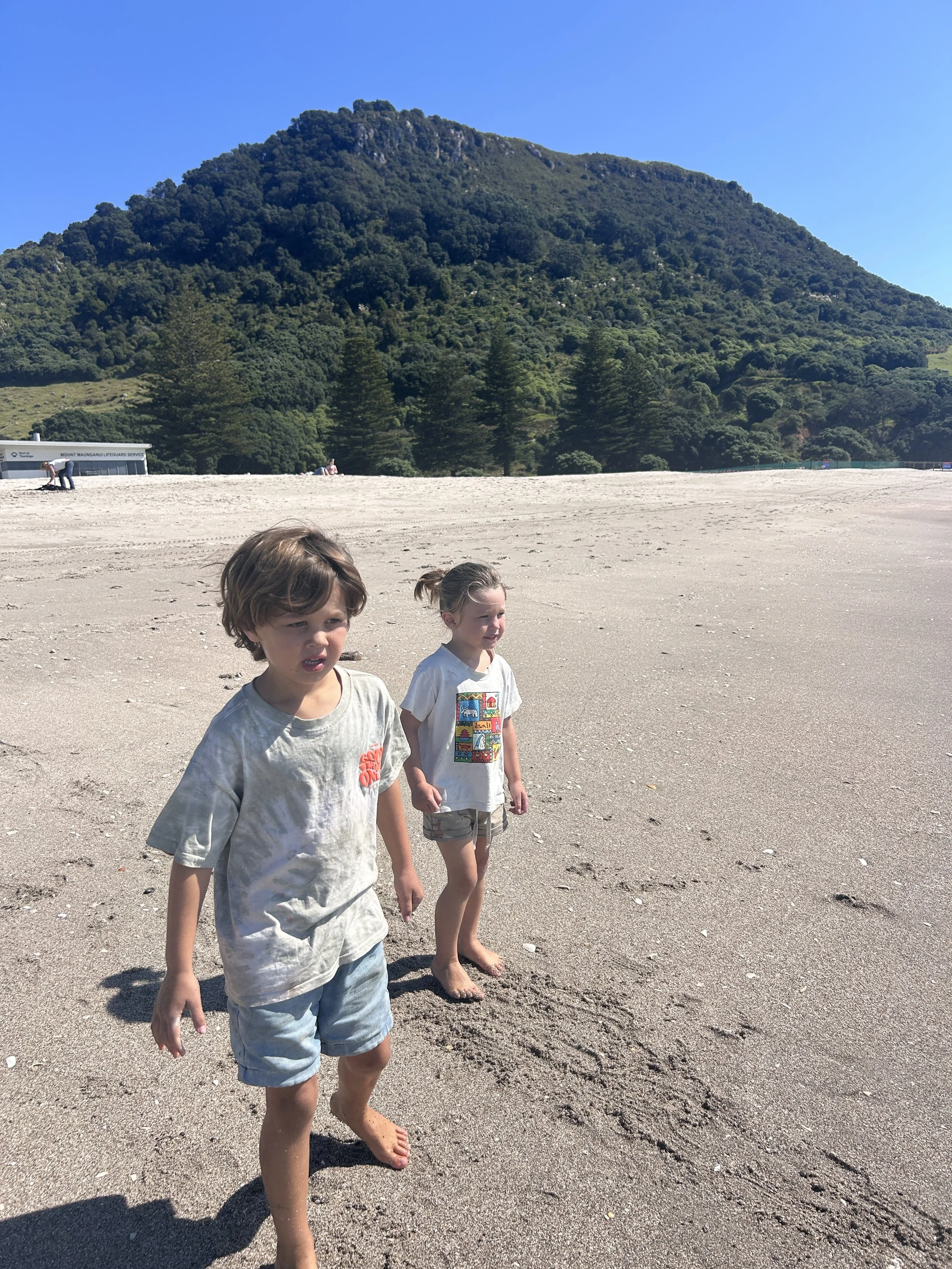
Picture this we were having the most beautiful day on the Mount beach. My moko and I had spent the morning down by the water’s edge, completely immersed in play, you know the game - how far can I go into the water before the waves get me. This always creates laughter. Then something disrupted the play. It wasn’t a major thing. Just enough to create a little crack in the picture I had unconsciously created about how the day should unfold.
So we repositioned ourselves. We moved further along the beach. We stopped for an ice cream. Then we wandered to another area where Archie loves to climb. Now here’s the thing - Archie is confident climbing. I am not always a confident watcher of Archie climbing. After a few moments I could feel it happening in my body before I fully recognised it in my mind. My stress levels began rising. My voice changed. “Archie, careful.” “Archie, don’t.” “Archie…”.
Eventually I realised that I was the one struggling in that space, not him. So we moved again. We found the most magical place. The tide was right out and the rock pools were full of treasures and possibilities. We settled into play and I found myself thinking, Yes. This is it. We could stay here all day. My image of myself as the calm, curious, playful Nana was back intact. I had returned to me.
Then one of them looked at me and said:
“I need to go to the toilet.”
My immediate internal response? “WHAT!” It was a really loud WHAT in my head and a more gentle ‘oh” response audibly.
Not because going to the toilet was unreasonable. Not because he had done anything wrong. Not because it was even particularly difficult. But because my plan had been interrupted.
My picture of the day. My expectation. My image of us clambering over rocks, finding crabs, shells and treasure was lost.
All of a sudden my internal dialogue started racing:
We were just settling in.
Now we have to pack everything up.
We have to find a toilet.
Why now?
.
Of course, we went and found a toilet. Of course, it was absolutely fine.
But the moment stayed with me because it reminded me how quickly we as adults can move into dysregulation - not because of the tamariki, but because of ourselves. Because our expectations have been disrupted. Then something even more important happens. Once we recognise our response, another layer begins.
The self-talk. I’m such a bad nana. Why did I react like that? I should be calmer than this.
Now we’re not only dysregulated from the moment itself - we’re dysregulated from our shame about the moment.
Dysregulation in Early Childhood Spaces
As kaiako, we often talk about tamariki becoming dysregulated.
But what about us? Because sometimes what I observe in early childhood settings is not tamariki “causing” stress, but adults carrying stress that has quietly accumulated.
Stress from rushed transitions.
Stress from tight rosters.
Stress from trying to meet everyone’s needs simultaneously.
Stress from expectations that don’t match reality.
Stress from the picture of an ideal day being disrupted.
Sometimes it can be when multiple tamariki transition into the setting in the same week. Kaiako want to offer beautiful, responsive one-to-one settling experiences. They want to truly hold space for mokopuna and whānau. But when too much is happening at once, the nervous system begins carrying overload.
Sometimes it’s the pressure of time. “We’ve got 30 nappies to get through before morning tea.” Suddenly care becomes task-oriented rather than relational.
The body tightens.
The voice changes.
The nervous system shifts into survival mode.
And often the first thing to disappear is softness. The hand that, when regulated, gently reaches out and says:
“Can I help you?”
“Shall we go together?”
Becomes the hand that holds a wrist not the hand and says:
“Come with me.”
One is grounded in connection.
The other is grounded in control.
Usually underneath control is not “bad teaching.” It is dysregulation created by our internal voice, our interrupted expectations of the day or stressors in the environment
The Wairua of the Space
What is also important to understand is that when kaiako become dysregulated, it shifts the wairua of the space.
Everybody feels it.
The tension.
The urgency.
The tightness.
And tamariki often feel it first. We cannot fake regulation because tamariki are constantly reading us beyond our words. In the book Scattered Minds, Gabor Maté talks about children reading emotions through our eyes. They are searching for congruence between what we are saying and what we are actually feeling.
We might use calm words. We might smile. We might respond.
But if our nervous system is dysregulated, tamariki will sense it.
They watch our eyes. Our posture. Our breathing. Our movements. They listen to our beating heart. The pace of our responses. They feel the wairua of a space long before they fully understand the language within it. The wairua of a space is shaped not only by the physical environment, but by the emotional presence of the adults within it. This is why emotional wellbeing in early childhood settings cannot only be about tamariki. It must also be about kaiako. Because regulated adults help create spaces where the wairua feels calm, safe, and connected. Dysregulated environments often emerge not from lack of care, but from adults carrying too much stress for too long without opportunities to reset.
So perhaps one of the most important reflective questions for our teams is:
What wairua are we creating in our spaces?
And alongside that:
How are we protecting and supporting the wellbeing of kaiako so that tamariki experience safety, calm, and connection?
Because wellbeing is contagious. So is stress.
Returning to Calm
The beautiful thing about my beach moment is that the story didn’t end there. I regulated. Not perfectly. Not instantly. But intentionally. I returned to presence.
To nature. To connection. To the reason we were there in the first place. We ended up having an amazing day.
That matters because teaching is not about never becoming dysregulated. It is about recognising when we are. It is about noticing the inner voice becoming louder.
Noticing our body tightening. Noticing when we move from connection into control. Research tells us regulation is not just cognitive. We cannot simply “think” ourselves calm. There needs to be interruption.
Breathing.
Grounding.
Cold water on the face.
Feet on the whenua.
Movement.
Pause.
Something physical that interrupts the nervous system response and helps us return to ourselves.
Returning to ourselves…
Perhaps regulation is not about becoming a perfect educator who never feels stress, frustration, or overwhelm.
Perhaps it is about learning how to return to ourselves.
To notice when we have moved away from connection and toward control.
To recognise when our nervous system has taken over.
To ground ourselves again in ways that bring us back to presence, calm, and relationality.
Because tamariki feel what we carry.
And they also feel when we return.
How do we remember that sometimes the most important work is not maintaining OUR perfect day… but considering the rhythm, curiosity and lead of the mokopuna to support their perfect day.
Dysregulation can move us away from ourselves, our way of being and who we are as kaiako and people. Regulation is the journey back.